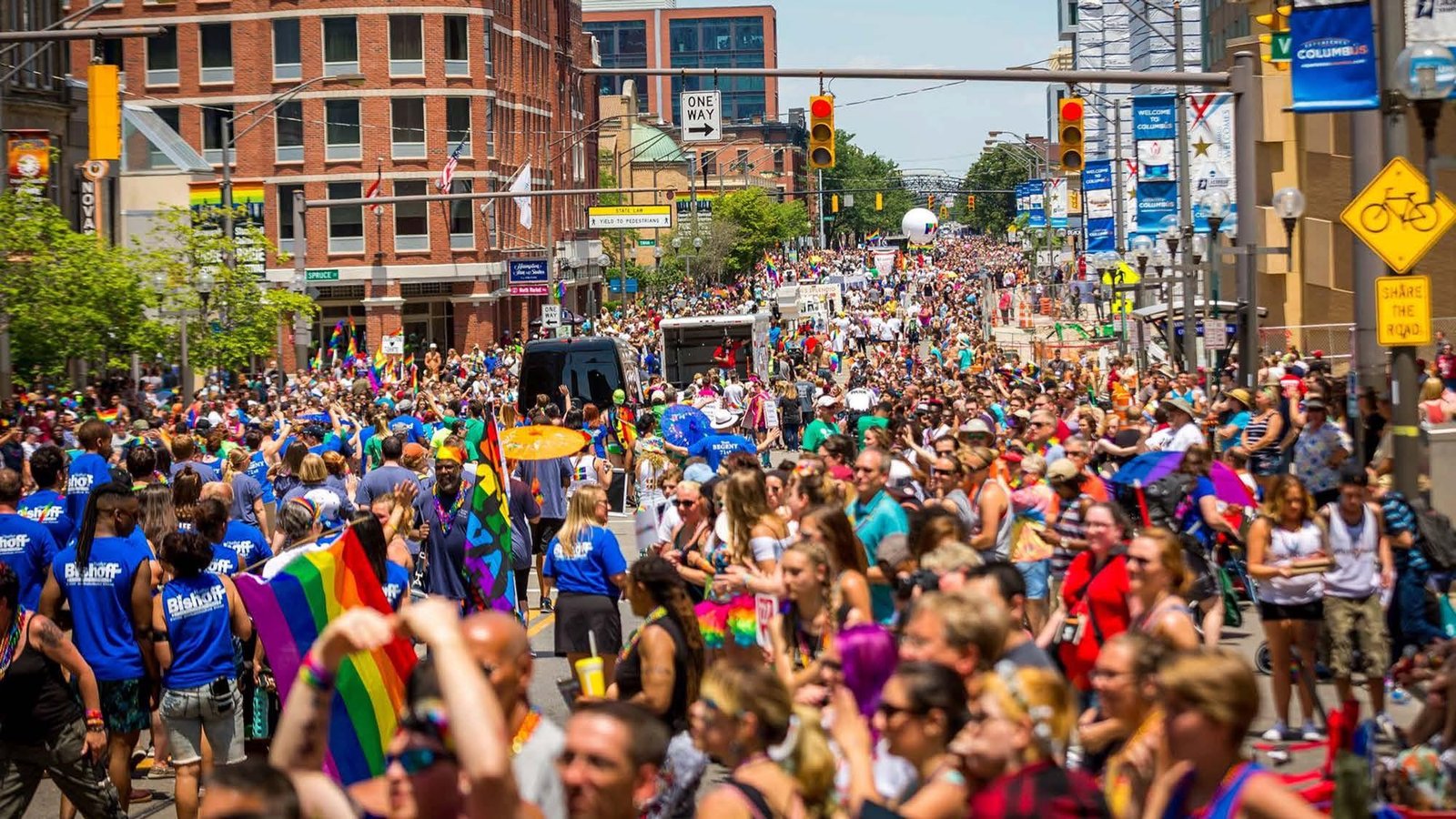
Walking through Stonewall on a Tuesday afternoon, I watched a teenager show her mom where the brick supposedly went through the window. Mom did not know the story. The kid told it the way you tell a family legend. She knew the year, she knew the names, she knew the difference between Marsha P. Johnson and Sylvia Rivera by face. The plaque on the wall did the official work. The kid did the rest. This is Pride 2026, and the map keeps redrawing itself.
I keep coming back to that kid, because everything else about this year’s Pride argues against her existing. The polling is moving backward. The Supreme Court spent the spring pulling nails out of the floor. The legislative session set a record nobody wanted. And a sixteen-year-old stood in front of a bar in Greenwich Village and taught her own mother the family history. Both of those things are true at once. That is the whole assignment this year: holding both.
The ground we are standing on, briefly
A short history check, because the year keeps demanding one. The 1969 Stonewall uprising in New York is the event most people know, the brick-through-the-window story the teenager was telling her mom. Before Stonewall there was the 1959 Cooper Donuts riot in Los Angeles, and the 1966 Compton’s Cafeteria riot in San Francisco, both led by trans women of color, both still mostly absent from the version of this history that makes it onto cable. The first Pride march in June 1970 was a one-year anniversary of Stonewall, not a parade. It was a protest, with permits the organizers had to fight for, and it walked from Christopher Street to Central Park.
Go back further and the pattern gets clearer. In the 1950s the federal government ran what historians now call the Lavender Scare, purging thousands of gay men and lesbians from government jobs on the theory that their existence was a security risk. Police raided bars as routine practice. Newspapers printed the names of the arrested. The closet was never a metaphor about shyness. It was infrastructure, built on purpose, enforced by the state, and it took organized rage at a Village bar to start tearing it down.
From there: the 1973 removal of homosexuality from the DSM. The early-1980s AIDS epidemic, which the Reagan administration ignored on the record for years. The NAMES Project AIDS Memorial Quilt, first displayed on the National Mall in 1987, larger than a football field. ACT UP‘s direct action that forced FDA reform. Don’t Ask, Don’t Tell repealed in 2011. Obergefell in 2015. Bostock in 2020. Every one of those wins is a real thing, and every one of them is being tested in the present tense.
The numbers tell on us
June 3 of this year, Gallup published its annual Values and Beliefs survey, and the line on Republican support for same-sex marriage fell out of the chart. From 55 percent in 2021 and 2022 to 37 percent in 2026. As NPR put it, two decades of cultural change in one direction have started to bend the other way, and the bend is concentrated in one party.
The Supreme Court spent the term picking at the floorboards. On March 31, 2026, the Court ruled 8-1 in Chiles v. Salazar that Colorado’s law banning conversion therapy for minors violated a counselor’s First Amendment rights. The decision will be the basis for striking down most state and municipal protections of the same kind for years to come. The Trans Legislation Tracker counts close to 800 anti-trans bills introduced in US legislatures in 2026 alone. About a hundred have already passed.
None of this playbook is new, which is exactly why it works. Anita Bryant ran the same campaign in 1977, a citrus spokeswoman turning “protect the children” into a national fundraising engine, and the drag bans moving through statehouses right now recycle her script almost word for word. I wrote about that machinery earlier this month, in the piece on why the drag bans were never about children. The target rotates. The frame never does. In the 1950s it was security. In the 1970s it was teachers. In the 2020s it is libraries and locker rooms. The consistency is the tell, and it is also the weakness, because a playbook this old can be named out loud, and naming it has beaten it before.
This is the structural reality the kid at Stonewall has inherited. The legal scaffolding is being kicked at deliberately and on schedule, and the public sentiment that built it is splitting along the same partisan line that splits everything else.
What this Pride is for
There is a version of this conversation where Pride 2026 becomes the year we declare a state of emergency. That instinct is honest. The numbers earn it. I want to push past it anyway, because every time the movement gets pulled toward its loudest fights, the cultural infrastructure that made any of this possible gets neglected, and the next generation arrives in a culture that does not know its own grandparents.
The kid at Stonewall is the answer to that. She knew the story because somebody told her. Probably a teacher, probably a Pride Month essay, probably a TikTok by a drag queen who knew Marsha’s birthday. The transmission is the part we tend to skip when we are tired, and it is also the only thing that has ever actually worked.
Here is what makes queer transmission different, and fragile. Most cultures pass their history down through the family. Ours mostly cannot. The average queer kid is not raised by queer parents, does not inherit the stories at the dinner table, and arrives at their own identity with no elders attached. Every generation has to be handed the history sideways, through chosen family, through bars and bookstores and drag mothers and, now, through screens. That handoff has broken before. AIDS killed an entire generation of the people whose job it was to remember, and the community spent two decades rebuilding the archive from grief.
Which is why the transmission in 2026 looks the way it does: improvised, distributed, and running on whatever infrastructure the moment allows. A drag queen doing Marsha P. Johnson’s biography in a three-minute video reaches more sixteen-year-olds in a week than a university press reaches in a decade. A library display in June does quiet work in a town where the parade will never come. None of it is official. None of it is funded. All of it is the same handoff the bars and the bookstores used to make, moved onto new rails because the old rails keep getting pulled up. The kid at Stonewall learned the story on some version of those rails. The people tearing them up understand exactly what they are for. The quilt on the Mall was mourning, and it was also a backup drive, panel after panel of names the culture was refusing to say.
The longer view
The visibility itself is older than most people think. The first openly queer media celebrity in modern American life was probably Al Hirschfeld‘s favorite subject, a circuit of New York performers in the 1920s and 30s, then forgotten by the official histories for fifty years before the New-York Historical Society’s archival projects on AIDS-era New York began pulling them back out. Queer history has always been there. It has only intermittently been allowed to be visible.
That fifty-year forgetting is the thing to study, because it is the outcome the current rollback is designed to produce. You do not need to make a people illegal if you can make them unremembered. Pull the books from the school library, ban the drag story hour, chill the teachers into silence, and the next generation grows up believing queerness arrived on the internet in 2012. A movement that knows its own ancestors is harder to disappear. A culture that knows where the brick went through the window is harder to convince that none of this matters, that the gains are over, that the new rollback is the natural state of things.
What I am going to do about this
Keep writing. The journal exists in part for the kid at Stonewall. The pieces about horror as the queerest genre, about Madonna and the mechanics of queer survival, about the gay clubs that built modern pop, about the artists and the moments and the brick through the window, are the transmission. The political fights are real and necessary, and I will not pretend the rollback is not happening. But the work in front of me, in front of any of us who write, is to make sure the next teenager at Stonewall already knows the story. So her mom can hear it from her.