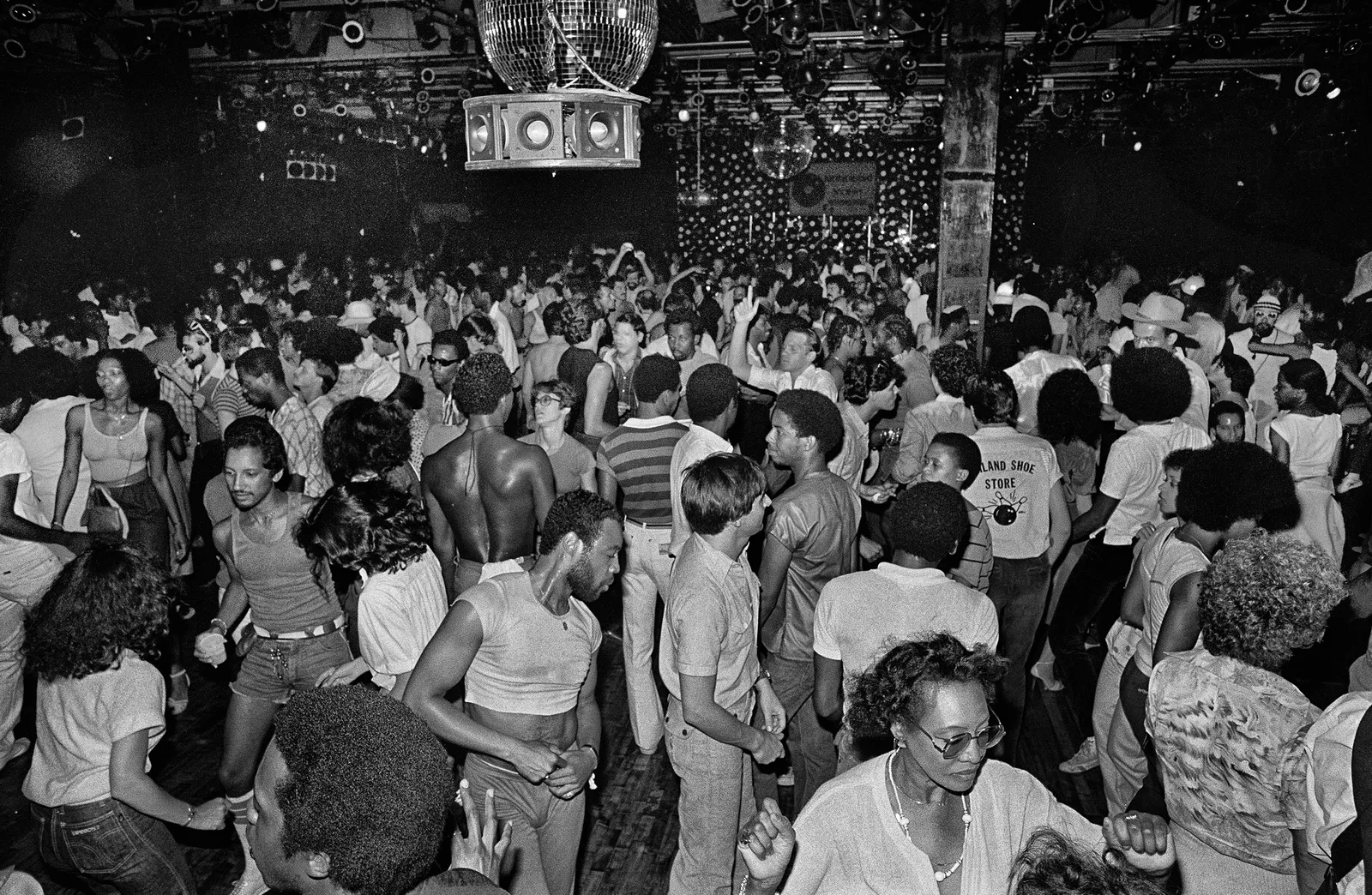
The pop song in your headphones was built, somewhere down the line, in a room the industry once treated as disposable. A membership card at the door. No bottle service. No celebrity section. Black and Latino queer people dancing until morning because the dance floor offered a freedom the street outside did not.
The kick drum, the extended breakdown, the diva vocal, the remix, the DJ who reshapes a record around the needs of a crowd, the whole expectation that a song should move a room like one body: modern pop inherited these ideas from club culture. The line is not perfectly straight, and no single room invented dance music. The history is still clear. Queer clubs served as laboratories where records became forms, formats, and eventually an industry. Pop kept the inventions and misplaced the address.
The room came before the genre
David Mancuso began hosting invitation-only parties at his Broadway loft in 1970. He described himself as a musical host rather than a DJ, playing full records instead of treating the set as a display of technical dominance. The Loft avoided the commercial rules of a nightclub. It sold no liquor, worked around New York’s restrictive cabaret laws, and built its identity around sound, hospitality, and the emotional movement of the crowd.
That model traveled. The Paradise Garage opened in 1977 as a membership club inspired by the Loft, with no alcohol and no general public at the door. Its audience was largely Black and Latino gay men. The room centered Larry Levan, who worked with audio designer Richard Long on a sound system built to make the music physical. His weekend sets ran deep into the next day, and records he favored could move from the dance floor to radio and retail.
This was a feedback system before the music business had a name for it. DJs tested records on people who knew exactly when a groove failed. Producers visited to hear what the room did with their mixes. Labels learned that a club could function as research, promotion, distribution, and criticism at once. The audience was not waiting at the end of the pipeline. It was helping design the product.
Disco was a social technology
Disco is often narrated as a collection of stars and hits, but the deeper invention was social. The music made room for dancing without a partner, for a DJ rather than a band, for a long night whose emotional arc mattered more than the three-minute single. It gathered people across racial, sexual, and class lines inside spaces where the dominant culture had given them few safe places to gather at all.
That is why Sylvester matters as more than a singer with an impossible falsetto. “You Make Me Feel (Mighty Real)” turned queer self-recognition into a dance-floor command. He did not disguise himself to become legible to the mainstream. The glamour, gospel force, gender play, and unapologetic desire were the record. The song entered the Library of Congress National Recording Registry decades later, after the culture had learned to call its influence history.
Donna Summer and Giorgio Moroder’s “I Feel Love” changed the machinery from another direction. Its electronic pulse pointed toward synth-pop, house, techno, and nearly every strain of programmed dance music that followed. The club did not invent every device used in the studio. It gave those devices a purpose. The machine had to carry a body through the night.
The backlash heard who was dancing
By 1979, disco had moved from underground rooms into television, movies, radio, and stadium-scale commerce. The mainstream version grew whiter, richer, and easier to sell. Then came the punishment.
Disco Demolition Night drew roughly fifty thousand people to Comiskey Park on July 12, 1979. Fans brought records to be blown up between games of a White Sox doubleheader. Thousands stormed the field, fires broke out, and the second game was forfeited. The stunt was promoted as a joke about musical taste. PBS and NPR have both documented the harder reading that followed: the records marked for destruction came from a culture associated with Black people, Latinos, women, and gay men, and many people in the crowd understood what else was being rejected.
Vince Lawrence, a young Black usher working that night, later recalled a man snapping a record in his face as if Lawrence himself embodied disco. He went on to help make early Chicago house records. That sequence matters. The backlash did not kill the music. It pushed the music back toward the communities that had built it, where it changed shape again.
House music kept the room alive
In Chicago, Frankie Knuckles took the disco continuum into the Warehouse, a club whose audience was largely Black, Latino, and gay. When new disco releases became harder to find, he extended old tracks with reel-to-reel edits, added drum-machine rhythms, and built sets that could keep dancers moving across a whole night. Grammy’s history of house quotes his description of the genre as “disco’s revenge.”
The name itself came from the room. Record-store customers asked for the music they heard at the Warehouse, and the phrase shortened into house. This was not a clean birth certificate signed by one person on one night. Chicago had many DJs, producers, clubs, radio shows, and dancers shaping the sound. The Warehouse remains central because it shows how the process worked. The audience’s needs became production choices. Production choices became a genre.
Detroit techno developed through a distinct Black electronic tradition, with Juan Atkins, Derrick May, and Kevin Saunderson imagining machine music through futurism, European electronics, funk, and the industrial city around them. It belongs in the same family tree without being folded carelessly into the same origin story. Pop inherited from both cities: Chicago’s bodily insistence and Detroit’s engineered future, carried around the world by clubs that knew the machine could feel human.
The club redesigned the record
Club culture changed the object itself. Tom Moulton developed the extended disco mix because dancers needed a record to last longer and because a groove could become more powerful when the structure opened up. The twelve-inch single followed partly by accident, when a mix was cut onto a larger disc and sounded louder and wider. The format became a standard tool for DJs.
The remix grew from that same pressure. A song stopped being a fixed master and became material that could be rebalanced, lengthened, stripped down, or rebuilt for another room. Larry Levan’s mixes made bass, percussion, silence, and repetition into dramatic tools. Frankie Knuckles used edits and drum machines to bridge gaps in the available music. The DJ moved from selector to producer because the room demanded more than the released record could provide.
Modern pop now treats these ideas as ordinary. Every major single arrives with alternate versions. The drop is engineered for bodies and clips. Producers test songs against club systems. Dance breaks structure arena shows. The culture uses the tools constantly while presenting the club as a decorative backdrop, a place the star visits after the invention is finished.
Ballroom turned survival into style
Ballroom added another layer, creating a competitive art form, a family structure, and a vocabulary that mainstream culture now uses with little sense of where it came from. Its history reaches back through Harlem’s drag-ball tradition, but the modern house system took form after Crystal LaBeija confronted racism in the pageant circuit in the late 1960s and began building spaces specifically for Black and Latino performers in the early 1970s.
The houses offered chosen family as well as competition. Categories turned the skills required for survival into performance: realness, presentation, fashion, wit, movement, and the ability to command a room that had denied you ordinary authority. Reading and shade became verbal arts. That language still structures reality television, a connection I follow in Reading Is Fundamental. Voguing made poses, lines, and controlled exaggeration into a dance language.
Paris Is Burning documented the 1980s scene and reached theaters in 1991, the year after Madonna’s “Vogue” took the dance into global pop. Her dancers José and Luis Xtravaganza came from the ballroom world, and the song put names such as José Gutierez Xtravaganza and Luis Camacho before an audience that still rarely learned the names of the communities behind the form. The exposure mattered. The imbalance mattered too. A star could borrow the language and leave with the royalties while the people who developed it remained vulnerable to poverty, racism, transphobia, and AIDS.
Beyoncé’s Renaissance handled the debt more explicitly. She dedicated the album to her gay Uncle Jonny, thanked the pioneers whose contributions had gone unrecognized, and built credits and samples around Black queer artists and dance-music history. Credit does not settle every question about scale or ownership, but naming the lineage changes the terms. The room becomes visible again.
Credit has to become material
Recognition arriving decades late is still a pattern. Larry Levan died at thirty-eight. Frankie Knuckles received major honors after house had already generated fortunes across global pop. Sylvester died of AIDS in 1988 and left future royalties to Project Open Hand and the AIDS Emergency Fund, directing the money back toward the community while the records kept earning.
The proper response cannot stop at calling these figures influential. Influence is the word industries use when they want ancestry without obligation. Credit should appear in liner notes, documentaries, museum collections, licensing decisions, festival bookings, preservation work, and payment. The club was a workplace. The dancers were collaborators. The DJ booth was a studio with an audience inside it.
Pop history also needs the rooms themselves. The Paradise Garage building was demolished in 2018. Countless queer clubs have closed under the pressure of real-estate costs, policing, changing nightlife habits, and a culture happy to stream the sound without maintaining the places that make new sounds possible. When the room disappears, the archive loses more than an address. It loses the network where the next form would have been tested.
Listen for the room
The next time a pop record moves you, listen beneath the star. Hear the full record played at the Loft. Hear Larry Levan shaping a night at the Garage. Hear the Chicago drum machine extending disco after the industry declared it dead. Hear a ballroom commentator turning language into rhythm and a dancer making a category look like freedom.
The pop you stream carries the work of queer people who built public joy inside private rooms. They did more than supply an aesthetic. They designed how the record moves, how the crowd answers, and how the culture recognizes a hit.
Know whose house you are dancing in.