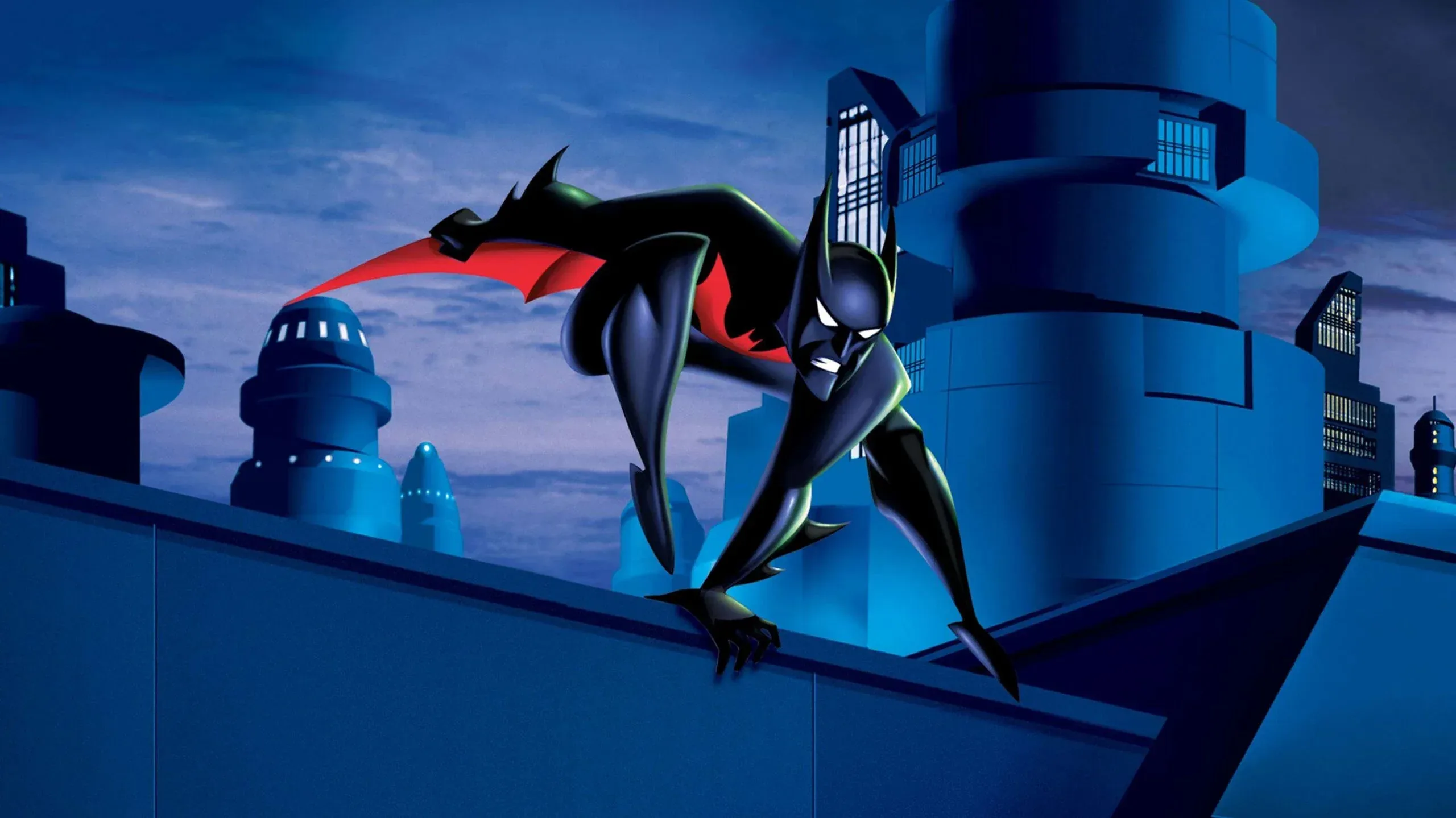
The pilot of Batman Beyond opens with one of the most quietly devastating images in superhero animation, and almost nobody talks about it correctly. An older, slower, visibly diminished Bruce Wayne is in the middle of a hostage situation, the kind of scene the show could have played as triumph, the legend pulling out one more win. Instead his heart starts going. The cowl gets heavy. He stumbles. And when the moment finally tips against him, he reaches for a gun.
He doesn’t fire it. He doesn’t have to. The reach is the whole thing. Bruce Wayne, the man whose entire identity is built on the refusal of that one object, the man for whom the no-guns rule is the closest thing he has to a religion, reaches for one because his body has finally stopped paying out the discipline he banked on it for forty years. He puts the cowl down that night. He doesn’t put it on again for twenty years. The series spends sixty-five episodes afterward asking, in increasingly painful ways, whether the masculinity that built him was ever survivable.
What Batman: The Animated Series coded as competence
If you grew up on the early-90s Bruce Timm Batman, you were taught, by a children’s cartoon, deliberately, week after week, that a particular bundle of traits added up to a man. Emotional containment. Bodily discipline. Secrets kept perfectly. Relationships managed at a distance. The capacity to absorb pain and reveal nothing. The capacity to be alone in a way that looked like strength rather than what it actually was, which was exhaustion deferred.
That cartoon is one of the great achievements of American television, and I don’t want to flatten it, Kevin Conroy gave that Bruce a private interior nobody else could find. But it’s also true that the show coded the lone-wolf model as functional. The discipline worked. The secrecy worked. The sacrifices were the price of the job, and the job was righteous, and so the math closed.
Batman Beyond arrived in 1999 and refused to let the math close. It kept every variable in place, same character, same code, same cave, and just let the clock keep running. The lone-wolf model doesn’t fail in the new show. It does exactly what it promised. That turns out to be the problem.
Bruce won. Look at him.
Here is the thing the series understands that almost no other piece of legacy superhero media has been brave enough to look at directly: the masculine ideal we celebrated in the original was a model designed to win. It was not designed to live with. There is no sustainable version of the man at the end of The Animated Series. There is only what he becomes when the wins keep coming and the years keep coming with them.
So the elderly Bruce of Batman Beyond is, technically, undefeated. He has the manor. He has the cave. He has the money. He has Ace. He has the reputation. He has, in the most literal sense, “won.” And he is one of the most isolated characters in American animated television. The boys he raised left. The women he kept at arm’s length stayed at arm’s length. Alfred is dead. Selina is somewhere. Dick won’t take his calls. The Justice League quietly stopped checking in. The discipline that made him effective made him impossible.
The cave hums. The dog whimpers. The man eats alone. This is what success looks like in the model. The series is asking, in the form of a children’s cartoon about flying punches, is this what we meant?
Terry McGinnis is not a replacement. He’s a counter-argument.
The thing the show does with Terry that I think gets missed by people who only remember the cool red-and-black suit is that he isn’t a successor in the way succession usually means. He doesn’t ratify the model. He doesn’t validate Bruce’s choices by carrying them forward. He’s loud. He talks back. He has a girlfriend he actually treats like a partner. He has a little brother he picks up from school. He has a mother who calls. He cracks jokes inside the cowl. He cries on camera. He complains.
Every single one of those traits, in the moral architecture of the original series, would have been coded as weakness, as something Bruce had to suppress to do the work. Terry does the work and keeps the traits. The show doesn’t pretend that’s easy. He gets it wrong constantly. But the gestalt is unmistakable: the next Batman wears the cowl differently because the version of manhood underneath it is different, and the difference is the point. Terry’s whole existence is the show saying the previous model didn’t have to be the only model. It was a choice. Look, here is what someone who made a different choice can do.
The mentor relationship that anchors the series is, then, one long argument disguised as gruff affection. Bruce in Terry’s ear, snapping at him to do it like he would have done it. Terry refusing, in small and large ways, dozens of times an episode. The show is not subtle about who is being corrected. The student is teaching the teacher how to be a person, one mission at a time, and the teacher is too proud to admit it’s working.
Why this still hits in 2026
I’m writing this in a year when a large, vocal slice of American men under thirty have decided, with the help of a content economy that profits from their loneliness, that the stoic-lone-wolf masculine model is something they would like to renovate and move back into. The “high-value man” content. The masculinity podcasts. The cold-plunge influencers. The clenched-jaw “your feelings are weakness” rebrand. The U.S. Surgeon General has gone so far as to declare an epidemic of loneliness and isolation, and young men are among its hardest-hit demographics. It is, for the people pushing it, an enormously profitable retreat into the exact ideal Batman Beyond spent sixty-five episodes diagnosing.
What’s striking about the show in retrospect is how completely it understood the appeal. It does not pretend Bruce isn’t impressive. It does not pretend the discipline isn’t real. The man did the thing. He paid the price he was told to pay and got the result he was promised. The horror of Batman Beyond isn’t that Bruce gets exposed as a fraud; it’s that he gets exposed as exactly what he was advertised as, and the advertisement was the lie.
The current crop of masculinity-influencer content is selling young men a future that, if they buy it and follow it for forty years, ends in the manor with the dog and the empty kitchen. Maybe with the money, sure. Definitely without anyone left to call. The show wasn’t speculative about that ending. It just drew it.
The cowl is on a stand
The image I can’t shake from the series is one that recurs throughout: the old cowl, displayed on a stand in the cave, behind glass, lit like a museum piece. Terry’s new suit is somewhere else. The old one sits there alone. The framing changes the meaning of every fight scene that comes after it. The cowl is not what Bruce became. The cowl is what Bruce wore until it ate him and then someone had to put it behind glass before it could eat the next person too.
That is the bravest thing this show did, and I think it’s why it has gotten quietly more important the longer it has been off the air. Batman Beyond is the rare piece of legacy superhero storytelling willing to ask whether the legacy was good for the legacy-holder. Whether the man we admired wanted to be the man we admired. Whether the lone-wolf masculinity that we keep handing to young men as a defensible default was ever a model designed for a person to live a life inside of.
The answer the show gives is no. Quietly, sympathetically, sixty-five episodes of no. And then it puts the cowl on a stand and asks the kid in the next generation if he wants to try this a different way.
The kid says yes. Bruce never quite forgives him for it, and the show is honest enough to show that, too.