A man stands on a stage and tells a story about something terrible that happened to him. The audience laughs at the wrong parts on purpose, because the comedian on stage has trained them to. Halfway through they realize the joke is on them. By the end, the line between the man telling the story and the men in the audience watching him tell it has thinned almost to nothing, which is the trick Richard Gadd has been refining since his first major Edinburgh show in 2016. That is the Gadd move. He has now made it three times, in three different forms, and each version has been about the same thing: what masculinity looks like when a man finally stops performing it long enough to describe it.
Half Man landed on HBO on April 23 and on BBC iPlayer the next day. It is Gadd’s third major work in ten years, after Monkey See Monkey Do (the 2016 Edinburgh Fringe show that won the Edinburgh Comedy Award and dealt with the sexual assault Gadd had survived four years earlier) and Baby Reindeer (the 2024 Netflix limited series that drew 84.5 million views in its first 91 days and made Gadd, briefly, the most famous Scottish writer in the world). Half Man pairs Gadd with Jamie Bell as step-brothers across thirty years, and from the reviews now on the record it does what the first two did: starts as a story about one specific damaged man and ends as a story about every man in the room, including the writer who keeps casting himself as the one being watched.
What the anti-hero era was actually doing
For twenty-five years prestige television produced an unbroken argument about what was wrong with American men. The Sopranos put Tony in a therapy chair in 1999 and asked an entire generation to spend six seasons watching a man fail to talk about his mother. Mad Men gave Don Draper a stolen identity and a wartime secret and let him drink across the 1960s without ever quite landing on what he was running from. Breaking Bad handed Walter White a cancer diagnosis and a chemistry set and watched him decide that the diagnosis was less interesting than the chemistry. Succession) wrapped the whole argument in a billion-dollar bow and let four siblings spend four seasons not knowing how to grieve their father, in a company that was going to be eaten anyway.
What those shows shared was a refusal. The presenting symptom is the refusal to name the thing underneath. Violence, addiction, infidelity are where it shows. The shows knew what they were doing. The audience, for a long time, did not. Tony Soprano became a meme. Don Draper showed up on coffee mugs. The Walter White Halloween costume outsold whatever the writers thought the show was warning against. The cultural read of these characters drifted, year after year, away from the writers’ actual argument and toward something closer to fan service for the men the writers were diagnosing.
By 2024 the form was exhausted. The fourth Succession season ended with Kendall on a bench by the river, and the conversation around the show was about which sibling deserved to win, not about whether any of them should ever have been allowed near the company. The argument had been won by the wrong side. Prestige television had described American masculinity with surgical accuracy for a quarter century, and the audience had decided to interpret the accuracy as flattery.
What Gadd did differently
Baby Reindeer landed on Netflix on April 11, 2024 into a culture that had stopped knowing how to talk about the male inner life. Gadd’s move was simple and almost mean. He cast himself, in his own story, as the man being stalked and previously assaulted, and then refused to let his character off the hook for any of the choices that made the stalking possible. The autobiographical scaffolding mattered less than the structural one. The show kept turning the camera around on the audience that was rooting for Donny Dunn to be okay. It debuted with 2.6 million views, climbed to 13.3 million in week two and 22 million in week three, held the top spot on Netflix’s English-language TV chart for weeks running, and eventually became the platform’s tenth-most-popular English-language series of all time.
What Gadd added that the American anti-hero shows never quite managed was self-implication. Tony Soprano was an object the writers held up for examination; the audience was invited to watch. Donny Dunn is an object the writer holds up for examination, and the writer is also the object. The British alt-comedy tradition Gadd comes out of, the Frankie Boyle and Stewart Lee line of comedians who treat the audience as a hostile witness, is the structural source code. Gadd dropped it into a streaming drama. The form survived the transfer.
The pattern, three times
Monkey See Monkey Do (2016): a stand-up show about a man processing his own sexual assault by running on a treadmill for an hour while a figure in a gorilla suit tried to keep up. The treadmill is the gimmick; the gimmick is the point. He cannot stop moving long enough to say the thing, so he sets up a mechanism that forces him to. The show won the Edinburgh Comedy Award; Gadd became only the second Scottish-born comic in the prize’s history to take it home.
Baby Reindeer (2024): a seven-episode limited series about a man whose stalker becomes the most legible relationship in his life, partly because she sees him in a way no man he knows is willing to. The structural move is the same. The show forces a confrontation by removing the option to look away, then makes the audience complicit in the looking.
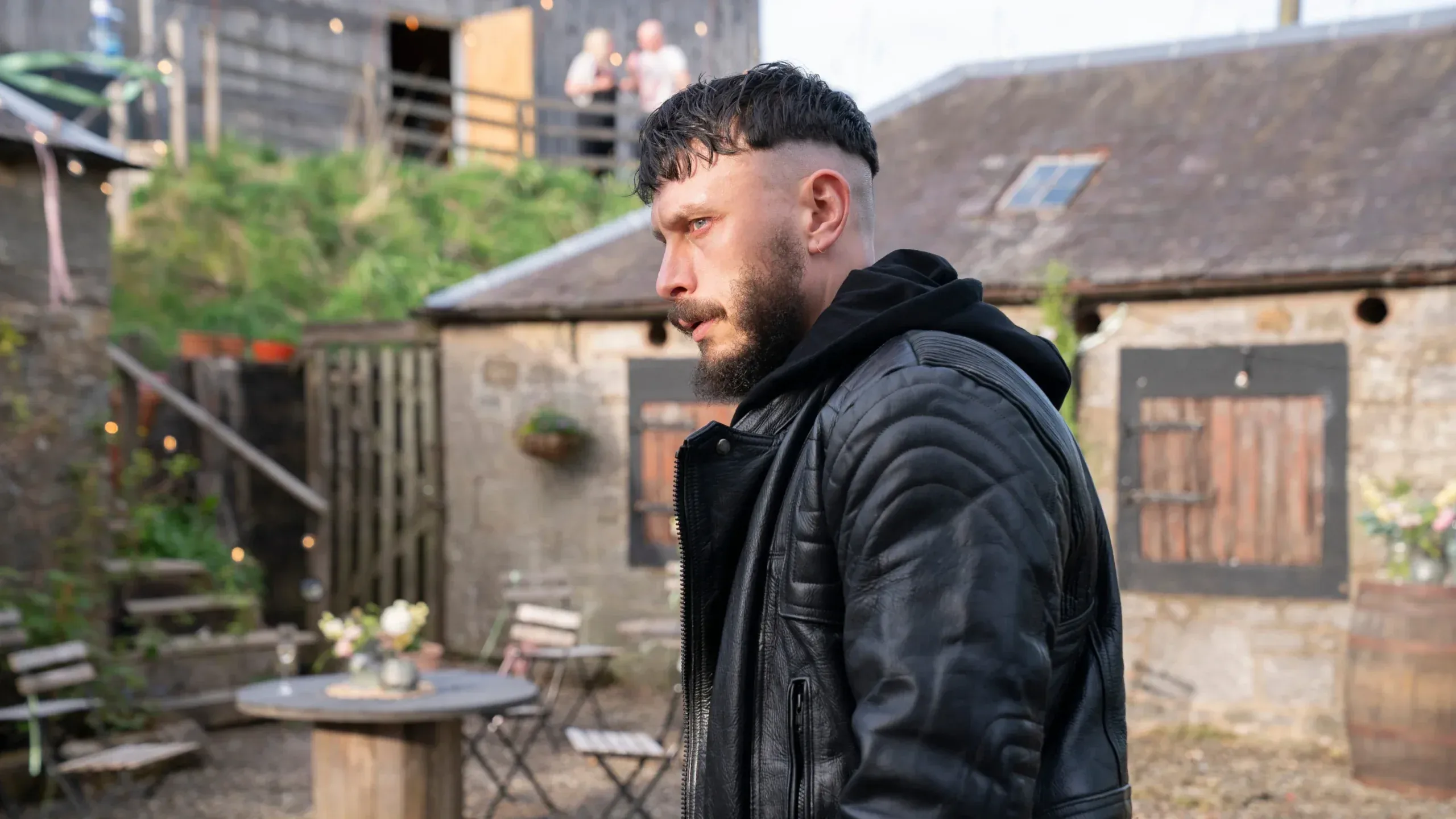
Half Man (2026): a six-episode two-hander spanning four decades, in which Gadd plays Ruben and Bell plays his step-brother Niall. The show opens at Niall’s wedding when Ruben turns up uninvited and on edge; a sudden act of violence catapults the audience back through the brothers’ shared past from the 1980s to the present. Inkoo Kang at The New Yorker) called the central relationship “thornier than any other male bond on TV” and praised Bell, “whose screen roles have long radiated decency,” for channeling that guilelessness into Niall’s quiet decency. The BBC’s Caryn James gave it four stars. The Independent’s Nick Hilton was the loudest dissent, two stars out of five, calling Gadd’s sophomore programme “a calculated attempt to make something brave and startling and important.” The argument cuts both ways. The show’s whole structural bet is that calculation is the alibi the form has been waiting to expose.
What unites the three is a refusal to use the anti-hero form as alibi. The American shows let their men off the hook by making them interesting. Gadd builds the form on the assumption that interesting is the alibi, and the show works only if the writer refuses to grant it.
Why this matters in 2026
The collapse of the streaming bundle and the consolidation around prestige limited series (tracked in trade press) has made the limited-series format the new dominant unit of serious television. The economics of the long-running anti-hero drama have stopped working. A network can no longer afford six seasons of a man failing to grow. What it can afford is one season of a man being held very still and forced to look at himself, and then a new show next year, with a different damaged man at the center and the same structural problem under his ribs.
Gadd is the writer who saw the form was changing and changed with it. Half Man works as the next move from a writer who understood that the prestige drama was a vehicle and the vehicle was about to be retired. The new show asks what the form looks like when the autobiographical scaffolding is gone and the structural move has to carry the whole weight. It does not relitigate Baby Reindeer; it does the next thing the form has been waiting for somebody to attempt.
The anti-hero era did not end because the audience got tired of difficult men. It ended because one specific Scottish writer walked into the form and pointed out, on camera, that the form was a way of avoiding the conversation it pretended to have. Half Man is about brothers. It is also about every show that came before it, and what those shows kept looking past on purpose.
That is the harder argument, and Gadd has spent ten years building toward it. The spring reviews suggest the audience is finally, mostly, ready to hear it. The ones who aren’t are exactly the readers the show was built to provoke.