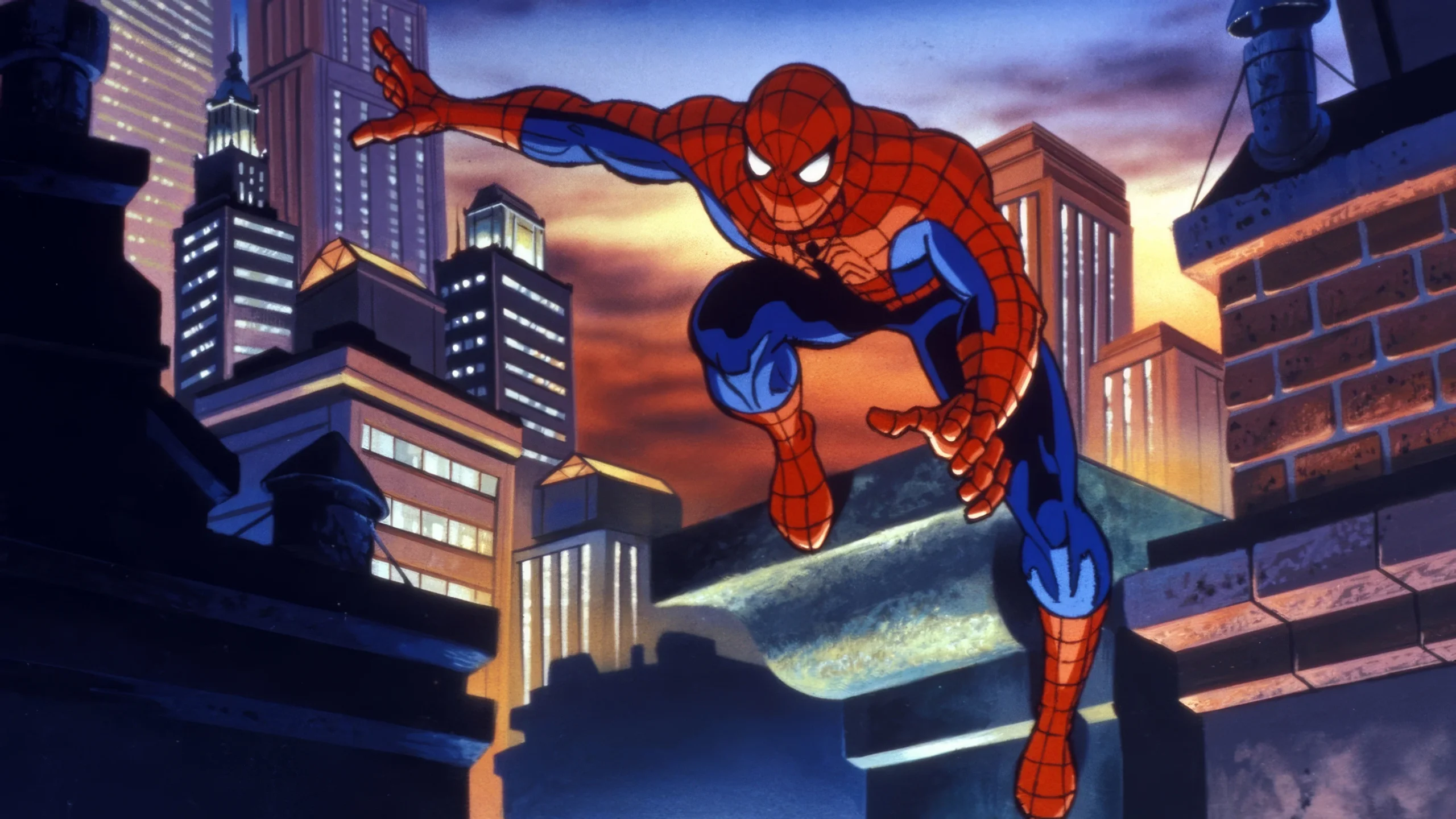
Here is the actual labor arrangement at the center of Spider-Man: The Animated Series, stripped of the costumes and the Stan Lee voiceovers, just the W-9 of the thing. A skinny twenty-something independent contractor takes photographs of his own near-death experiences. He walks the photographs five blocks to the only buyer in town. The buyer, who has no contract with him, no insurance obligation toward him, no formal obligation of any kind, looks at the photographs of the contractor almost dying, complains they’re not good enough, names a price designed to insult, and is then publicly furious at the contractor for the events the photographs depict, which are also the events that fill the buyer’s newspaper and make him rich.
The contractor is Peter Parker. The buyer is J. Jonah Jameson. The newspaper is the Daily Bugle. And the labor arrangement they make week after week is, in retrospect, one of the cleanest portraits of the gig economy ever put on American television, fifteen years before “gig economy” became a phrase a normal person would use.
Peter Parker has a job. The job is the problem.
One of the strange and quietly radical things about the 90s Spider-Man cartoon is that Peter’s heroism is not the part of his life that exhausts him. Punching the Rhino in the face is, comparatively speaking, the easy part of his week. The hard part is rent. The hard part is buying film, paying for darkroom supplies, getting to and from the Bugle, taking the call when Aunt May’s mortgage payment is due, eating something that isn’t toast.
The show never makes a big production of any of this. It just keeps showing you, episode after episode, that the texture of Peter’s life is precarity. A kid juggling a freelance photo career, college, an unstable side career he can’t put on a résumé, and a one-bedroom apartment whose ceiling leaks. The show treats it like wallpaper. It is, in fact, the structural ground of every story it tells. The villains of the week are interruptions to the labor crisis, not the other way around.
The Jameson arrangement is the gig-economy arrangement
Now look at what’s actually happening when Peter sells a photo to the Bugle, because if you describe it without the costumes it is one-to-one with what a 2026 ride-share driver does, what a delivery contractor does, what a TikTok creator does, what a freelance journalist does after their staff job got eliminated in the third round of cuts this year. The Pew Research Center has found that roughly one in six American adults has earned money through an online gig platform, and the fights over how those workers are treated have been raging in statehouses for a decade.
One. The worker bears the risk. Peter takes the photographs by going into the danger himself. The Bugle does not insure him. The Bugle does not authorize the danger. The Bugle does not even know about the danger until the photographs land on Jameson’s desk. The risk is borne entirely by the contractor, who has converted his own peril into the product.
Two. The platform captures the value. Jameson buys the photographs at a rate he sets unilaterally. He then resells them, bundled with editorial, at a multiple Peter never sees. The same image that nearly killed the contractor to produce becomes, in the buyer’s hands, recurring revenue. The contractor receives the one-time payment and goes home to his leaking apartment.
Three. The platform monetizes the worker’s image while disclaiming the worker’s existence. This is the Jameson masterstroke and the part of the cartoon that has aged into prophecy. The Bugle’s most profitable ongoing storyline is Spider-Man is a menace. Jameson sells papers by attacking the same man whose photographs fill his front page. The contractor’s brand becomes the platform’s content while the contractor himself is publicly rebranded as the platform’s antagonist. That is exactly what every creator-economy platform does to its top earners by 2024. Use the labor, sell the spectacle, treat the laborer as the problem.
Four. The worker manages multiple selves to survive. Peter the photographer. Peter the student. Peter the nephew. Peter the boyfriend. Spider-Man the brand. Spider-Man the body. The show is brutally honest about how exhausting that splitting is. The animation gives Peter the same drained-eyes look in act one of basically every episode, regardless of which version of himself is doing the talking.
The Bugle is every platform
The reason the cartoon scans as so much sharper now than it did in 1994 is that the J. Jonah Jameson arrangement, which looked at the time like a quirky comic-book convention, gruff editor, talented freelancer, the irascible buyer-seller dynamic of old-school journalism, turns out to have been the prototype of the dominant labor model of the early 21st century. Substitute “ride-share app” for “Bugle” and Jameson’s behavior tracks perfectly: take the contractor’s risk-bearing labor, sell it at scale, disclaim the contractor as an independent operator rather than an employee, and run a public-narrative side hustle that paints the contractor as the source of the problem the platform is profiting from.
The Spider-Man-as-menace headlines aren’t even a cartoonish exaggeration of the platform behavior. They are roughly what every major gig-work company does in its own press relations. The food-delivery contractor is the reason your order is late. The ride-share driver is the reason the fare is high. The freelance journalist is the reason the news is biased. Blame the worker; bank the spread.
The cartoon’s moral seriousness is its labor seriousness
Spider-Man’s famous ethical line, “with great power comes great responsibility”, gets quoted to death in a way that flattens it into a Sunday-school moral. The cartoon’s version is more interesting and a lot harder to live with, because it pairs the line with an entire economic condition. Peter’s responsibility isn’t abstract; it’s mediated, at every turn, by the question of how he’s going to pay for it. The web fluid costs money. The film costs money. The phone bill costs money. The villain damages his suit and there’s no Wayne Enterprises lab to fix it.
The show, brilliantly, never lets Peter solve the money problem for more than half an episode at a time. The Bugle pays him just enough to keep him in the arrangement and not a dollar more. That’s the gig economy too. The platform was never designed to make the worker financially stable. Permanently available, yes. Stable, never. Stability would let the worker leave. Instability is the leash.
And so Peter is always available. The cartoon makes the availability into a moral position, he’s there because someone has to be, but the structural reading is uglier. He’s there because nobody pays him enough to be anywhere else. The heroism and the precarity are the same condition seen from two angles.
What we should have learned
A generation of kids absorbed this show without registering what it was teaching them about labor, because the labor critique was wrapped in a punching costume. We came away with the line about responsibility and missed the line under it about extraction. By the time the language of the gig economy finally arrived in the late 2010s, an entire cohort of Spider-Man-raised millennials and elder Gen Z workers were already inside the Jameson arrangement and didn’t quite have the vocabulary to name it. The cartoon had the vocabulary. We just weren’t listening for it.
I’m not trying to make a 90s superhero show carry more weight than it can. It’s a cartoon about a guy who shoots webs at lizards. But the labor arrangement at its center is so historically specific and so prophetically accurate that it’s worth saying out loud: the most popular animated portrayal of a young American man in the 1990s was a portrayal of an exploited freelance contractor who could not afford to stop being exploited. The hero costume is the romance. The arrangement underneath it is the documentary.
Peter takes the picture. He walks the picture to the Bugle. Jameson lowballs him. He takes the money. He goes home. The rent is still due. The webs still need refilling. Out the window, somewhere in midtown, the next emergency is starting, and there’s no one else available to photograph it. There never is.
That’s the show. That’s also, increasingly, the country.