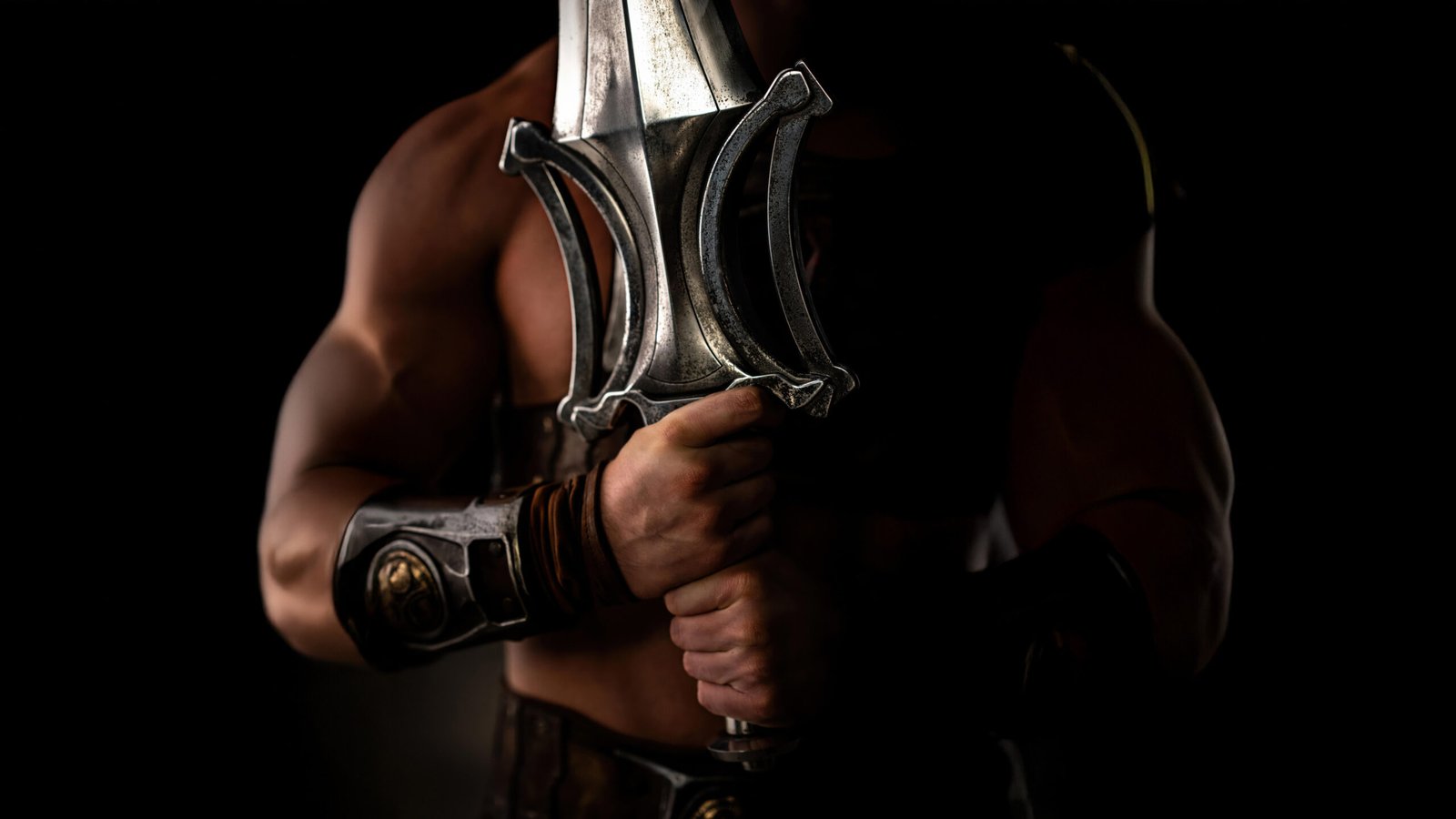
Here is the premise of He-Man and the Masters of the Universe, the toy line and cartoon that has, as of today, become a nine-figure Travis Knight live-action movie. A meek, soft-spoken prince named Adam lifts a sword over his head, shouts a secret phrase, and is instantly transformed into a towering, oiled, near-naked barbarian who is openly, dramatically, the most powerful man in the universe. He keeps this transformation a secret from everyone he loves. He has a fabulous double life nobody can know about. His arch-nemesis is a flamboyant theater-kid skeleton in a purple hood who lives in a castle and never stops monologuing.
I want to be very clear that I am not reaching. I did not invent any of that. That is the literal text of a 1983 children’s program created to sell plastic figures, and it is also, accidentally and completely, one of the most legible queer allegories in the history of American children’s media. He-Man has been a little bit ours since the Reagan administration, and the new movie, out in theaters today, is the first big-budget version that seems to actually know it.
The Tom of Finland of it all
Let’s start with the body, because the body is the whole thing. He-Man was designed in the early ’80s by a Mattel team explicitly chasing the Conan the Barbarian dollar, Arnold’s 1982 film had made the loincloth-and-broadsword aesthetic briefly the most bankable thing in Hollywood. But the specific way He-Man was drawn, the impossible chest-to-waist ratio, the harness that frames the pecs rather than protecting anything, the fur briefs, the boots, the total absence of a shirt in a series ostensibly about combat, lands somewhere a lot closer to Tom of Finland than to Robert E. Howard.
This is not a coincidence so much as a convergence. The visual language of hypermasculinity, the leather, the harnesses, the exaggerated muscle, the costuming that exists to display the body rather than clothe it, had already been claimed and amplified by gay culture by the time He-Man showed up. So when a children’s toy reached for “maximally powerful man,” it reached, without knowing it, into a visual vocabulary that gay men had spent two decades building. He-Man looks the way he looks because masculinity-as-spectacle was in the water, and gay culture had been mixing that water for years.
Skeletor is a theater kid and we all know it
And then there is Skeletor, who is, and I say this with total love, the most flamingly theatrical villain in the history of Saturday-morning television. The 1983 Skeletor, voiced by the great Alan Oppenheimer, does not simply scheme. He performs. He delivers withering put-downs to his own incompetent henchmen. He cackles, he sulks, he throws fits, he has a whole arch relationship with Evil-Lyn that plays like two divas fighting over a dressing room. He is camp in its purest form: a villain whose menace is inseparable from his flamboyance, whose evil is mostly a vehicle for fabulous line readings.
The reason the “Fabulous Secret Powers” parody, the early-2000s slash-dub of the original transformation sequence set to a euphoric gay anthem, went so viral and stuck around for twenty years isn’t that someone imposed a queer reading on an innocent cartoon; it’s that the queer reading was already sitting right there, fully assembled, waiting for someone to turn up the volume. You cannot parody something into being gay. You can only notice.
The franchise’s actual queer canon
If the original is queer by accident, its descendants have been queer on purpose. The single most important thing the Masters of the Universe brand has ever produced, from a representation standpoint, is Noelle Stevenson’s She-Ra and the Princesses of Power (2018–2020), a reboot of He-Man’s sister property that built an entire richly queer world and ended with its two female leads, Adora and Catra, confessing their love and saving the universe with a kiss. This wasn’t subtext; it was the climax. A generation of kids watched a Masters of the Universe property end on a canonical lesbian love story, and the sky did not fall.
Kevin Smith’s Masters of the Universe: Revelation (2021) carried that forward on the He-Man side, treating the mythology with the kind of operatic sincerity the material had always quietly deserved. The throughline from the accidental camp of 1983 to the deliberate queerness of the 2018–2021 reboots isn’t a corruption of the brand; it’s the brand growing up and admitting what it always was.
So what does the 2026 film actually do?
Travis Knight, the Laika animation savant behind Kubo and the Two Strings and Bumblebee, is, on paper, a strange and wonderful choice to bring He-Man to live action. And the early read on the film, out in theaters today from Amazon MGM, is that he has made the canniest possible version: one that plays the inherent silliness of the premise with a knowing wink rather than grim-dark embarrassment. Empire called it “a delightfully silly film for a perfectly stupid franchise,” which is precisely the right spirit. Knight has described Skeletor, played with relish by Jared Leto, who reportedly lobbied for the part, as the embodiment of toxic masculinity, which means the film’s own director understands that this story has always been, at bottom, an argument about what a man is supposed to be. Skeletor was always going to be the part that knows what kind of movie this is.
The casting of Nicholas Galitzine as He-Man is its own quiet joke, and a good one. Galitzine is the actor who became a star playing a gay prince in Red, White & Royal Blue, an actor whose entire screen persona is built on a kind of soft, knowing, self-aware masculinity, exactly the register a 2026 He-Man needs. Casting the internet’s favorite tender prince as the most powerful man in the universe is a wink. Whether the film fully leans into the inheritance or just gestures at it, putting that actor in the fur briefs is an acknowledgment of where this character has lived in the culture for forty years.
Why the camp matters more than ever
I write brand voice for studios for a living, so let me be cynical for one paragraph: the reason legacy IP like this keeps getting rebooted is that the recognition is free. Mattel does not have to teach you who He-Man is. You already know. The risk in these projects is never “will people recognize it.” The risk is “will the people making it be embarrassed by it.”
That is the whole ballgame with He-Man specifically, because the thing that makes him commercially valuable, the over-the-top, sincere, slightly ridiculous spectacle of it all, is the exact same thing a nervous studio is tempted to sand off. Every bad version of this character has come from someone being ashamed of the loincloth. Every good version has come from someone understanding that the loincloth is the point. Camp isn’t a flaw in the material to apologize for; it’s the load-bearing wall.
The queer audience figured this out in 1983. We looked at a muscle man with a secret identity and a flamboyant nemesis and a magic transformation that made him his truest, biggest, most powerful self, and we understood it immediately, because it was a story we already knew by heart. The transformation sequence, the lifting of the sword, the flash of light, the becoming, is a coming-out scene with the serial numbers filed off. I have the power is the most triumphant closet-door-kicked-open line in the history of children’s television.
Forty years later, there’s a version on the big screen that seems to finally get it. He was always a little bit ours. It’s nice to see him come home.